


In a development that feels equal parts unsettling and ingenious, researchers have unveiled a robotic hand that can detach from its arm, crawl away on its fingertips, grab objects, and then return to reattach itself. The concept challenges decades of robotics design that treated the hand as a passive tool fixed to an arm, instead presenting it as an autonomous, mobile agent. Far from being a novelty, this approach signals a deeper shift in how engineers think about dexterity, reach, and adaptability in machines.
Developed by a research team at EPFL, the project explores what happens when robotic design stops trying to faithfully copy human anatomy and instead focuses on function. The result is a machine that does not look or behave like a human hand — but can often do more.

Moving Beyond the Human Blueprint
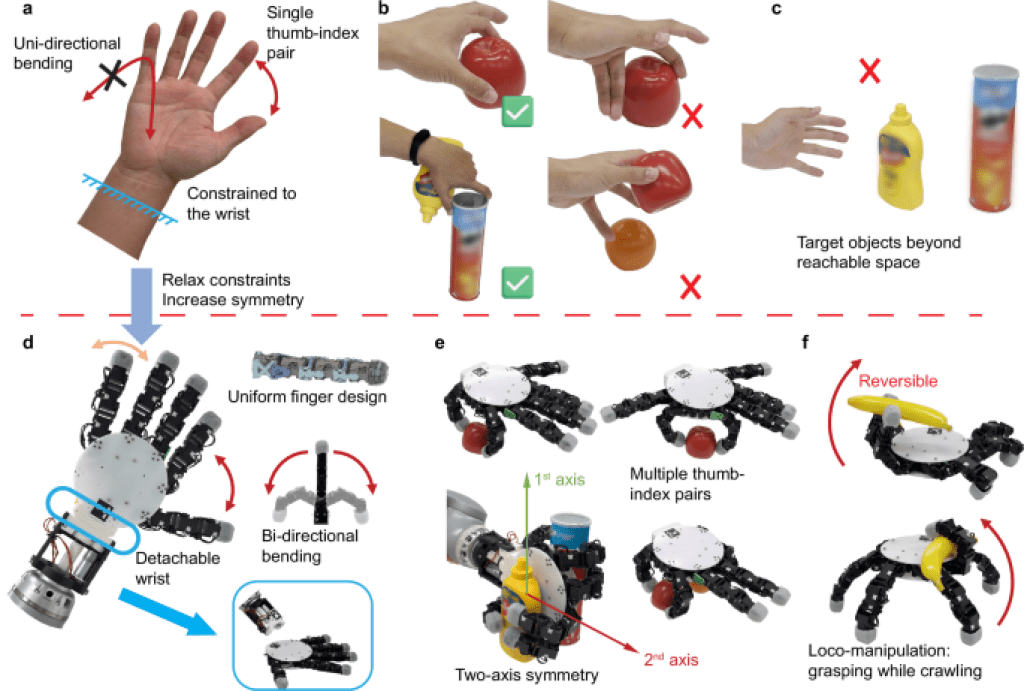
For years, roboticists have treated the human hand as the ultimate template. Five fingers, an opposable thumb, and joints arranged to mirror biology became the default standard for robotic manipulation. Yet this biological fidelity comes at a cost. Human-like hands are mechanically complex, fragile, and limited by the assumption that only one thumb–finger pair does most of the work.
The EPFL team took a different route. Their robotic hand is symmetrical and modular, with fingers that can bend both forward and backward. Any finger can oppose any other, eliminating the privileged role of a “thumb.” This symmetry dramatically expands the range of possible grasps and allows the hand to adapt its grip to objects of different shapes, sizes, and orientations without reconfiguring its entire posture.
Crucially, the design was not finalized by intuition alone. Machine-learning techniques were used to explore thousands of possible configurations, optimizing the hand’s geometry for stability, reach, and gripping efficiency. Instead of asking what a hand should look like, the researchers asked what it needs to do.

From Manipulation to Locomotion
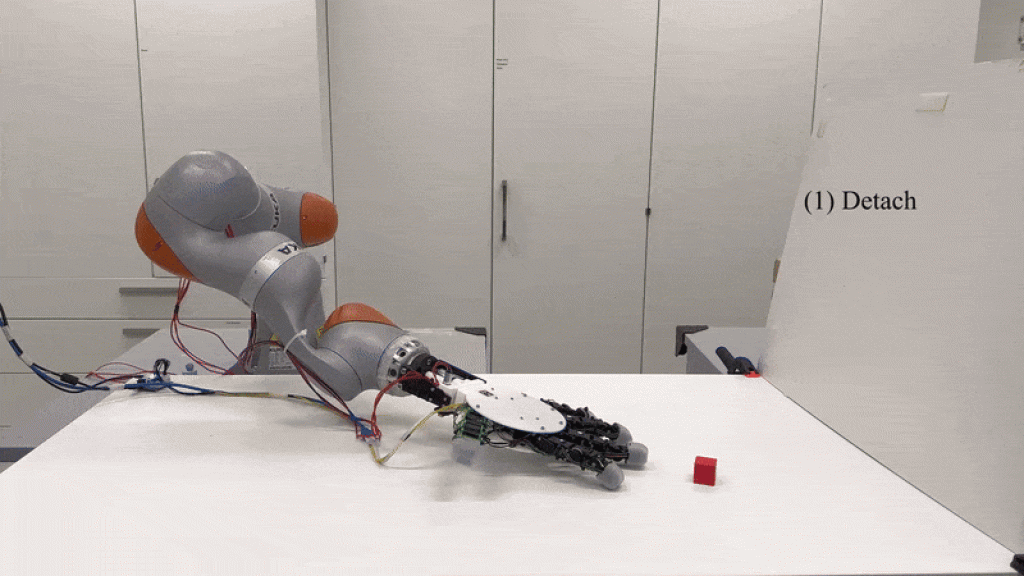
The most striking feature of the system is its ability to detach from the robotic arm entirely. Once separated, the hand does not become useless — it becomes mobile. By coordinating its fingers like legs, it can crawl across flat surfaces, navigate around obstacles, and reach areas that the arm alone cannot access.
This capability fundamentally changes the idea of reach. Traditional robots are limited by the length and articulation of their arms. If an object lies just beyond that envelope, the entire robot must reposition itself. A detachable hand, however, can bridge that gap independently, retrieve objects, and return without moving the robot’s main body.
In experimental demonstrations, the hand successfully crawled toward multiple objects, grasped them, and transported them back — sometimes carrying more than one item at once. This dual ability to move and manipulate blurs the line between end-effector and mobile robot, creating a hybrid system that behaves more like a biological organism than a factory machine.
Why This Matters in the Real World
While the imagery of a crawling robotic hand inevitably evokes pop culture references, its practical implications are serious. Many real-world environments are hostile to large, rigid robots: tight spaces, cluttered work areas, and unpredictable layouts remain major obstacles for automation.
A mobile, detachable hand could excel where traditional robots struggle. In industrial settings, it could retrieve components from dense shelving or machinery without requiring precise arm placement. In maintenance tasks, it might crawl inside equipment, pipes, or infrastructure to inspect or manipulate parts. In hazardous or disaster environments, such a system could reach into unstable or confined areas where sending a full robot — or a human — would be risky.
The research also raises intriguing questions for the future of prosthetics and service robotics. Rather than limiting artificial limbs to human-like motion, designers may eventually explore capabilities that extend beyond natural anatomy, provided control systems can adapt.

Key Features at a Glance
- Detaches from its robotic arm and moves independently
- Crawls using coordinated fingertip motion
- Uses symmetrical, reversible fingers instead of a single thumb
- Grasps a wide variety of objects and orientations
- Combines locomotion and manipulation in one system
Conclusion
The detachable crawling robotic hand represents more than a clever engineering trick. It challenges one of robotics’ most entrenched assumptions: that machines must resemble humans to work effectively in human environments. By abandoning strict biological imitation and embracing modularity, symmetry, and mobility, the researchers have opened a new design space for intelligent machines.
As development continues, refinements in autonomy, sensing, and control will determine how quickly such systems move from the lab into real-world use. But one thing is already clear: the future of robotics may belong less to machines that look like us — and more to machines that can go where we cannot.